NNW VOD Archive & Transcript Intelligence · Oct 2025 – Present
Search a broadcast archive and keep the answer tied to its source.
An automated preservation pipeline and research layer for finding exact moments across full-length broadcasts.
- Ownership
- Sole designer, engineer, and operator
- Primary users
- Researchers and media operators who need to find what was said, recover surrounding context, and jump to the exact archived moment.
Four views from the live archive: the VOD library, transcript search, a cited answer, and cross-archive language analysis.
The problem
The work starts before the interface.
Long broadcasts are difficult to preserve consistently and harder to search. Transcript text alone is not enough when an answer has to remain connected to the original footage.
Production interface
What the live product makes visible.
Each frame below is a direct capture of the operating product. The annotations describe the workflow decision the view represents.
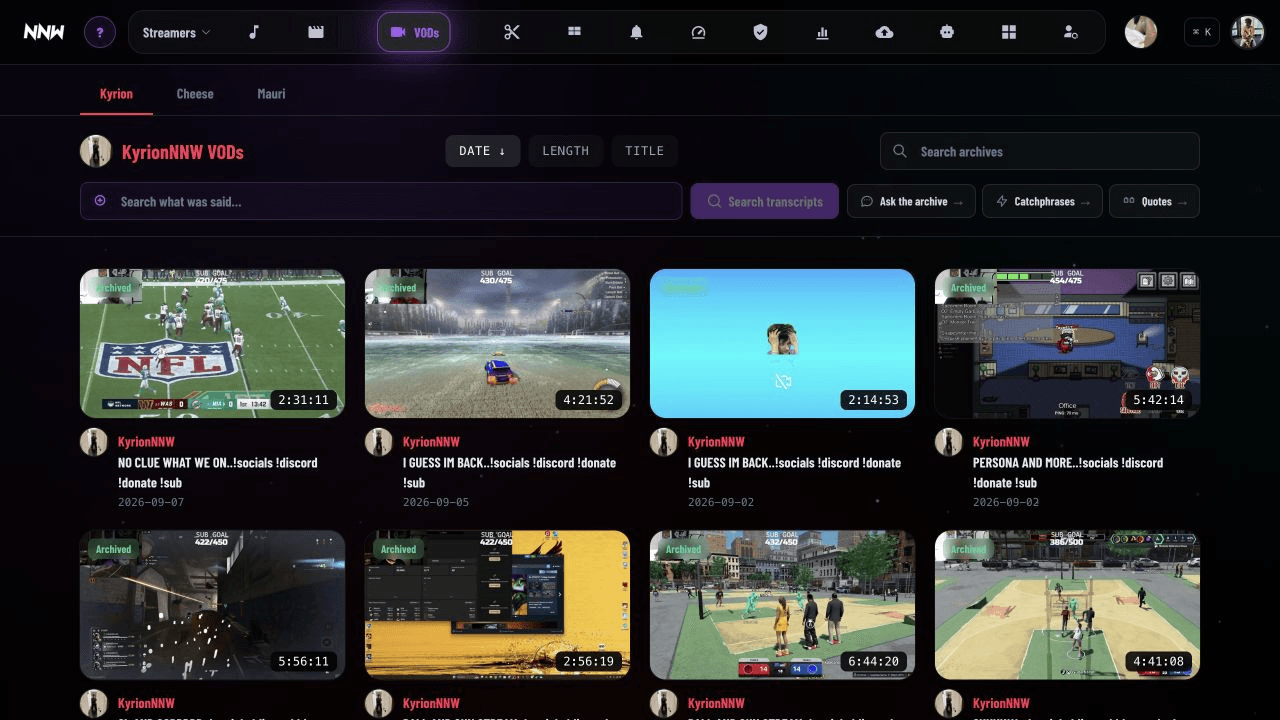
Preserve the broadcast record
The live archive exposes real public VODs with enough date, duration, and source context to begin research without a separate catalog.
- Automated ingest places new broadcasts into the same library.
- Public thumbnails make long recordings quickly recognizable.
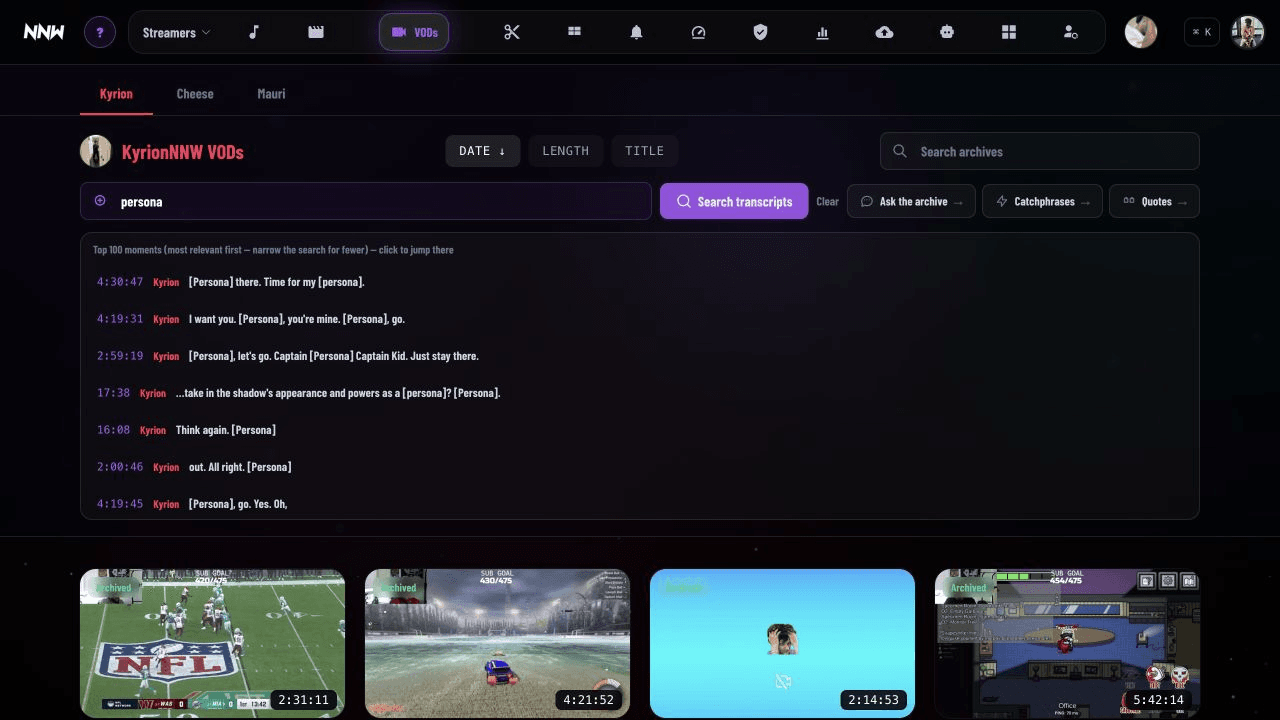
Search what was said
A production transcript query returns ranked excerpts with speaker context and exact timestamps instead of an undifferentiated text dump.
- Each result is a direct jump target into the source VOD.
- The query stays visible while the archive remains in view.
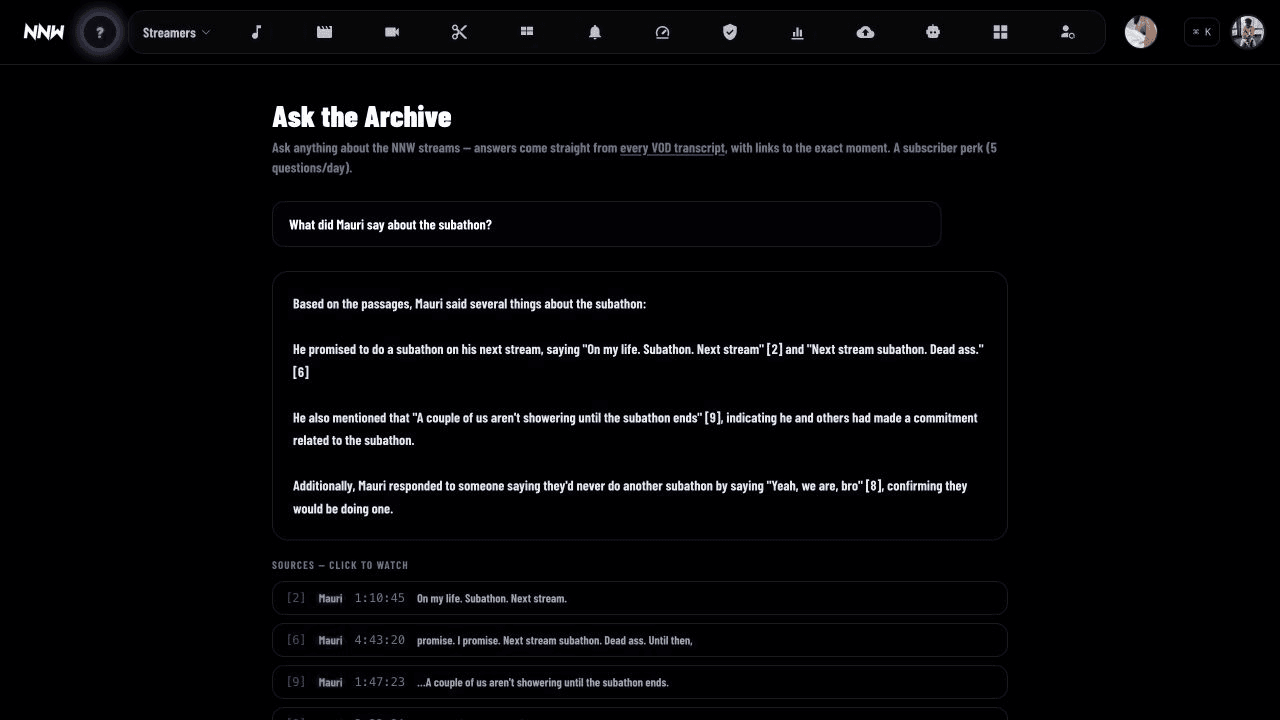
Answer with visible evidence
Ask the Archive produces a concise response while keeping the cited broadcast moments close enough to verify immediately.
- Retrieval happens before answer generation.
- Citations preserve the path back to the original footage.
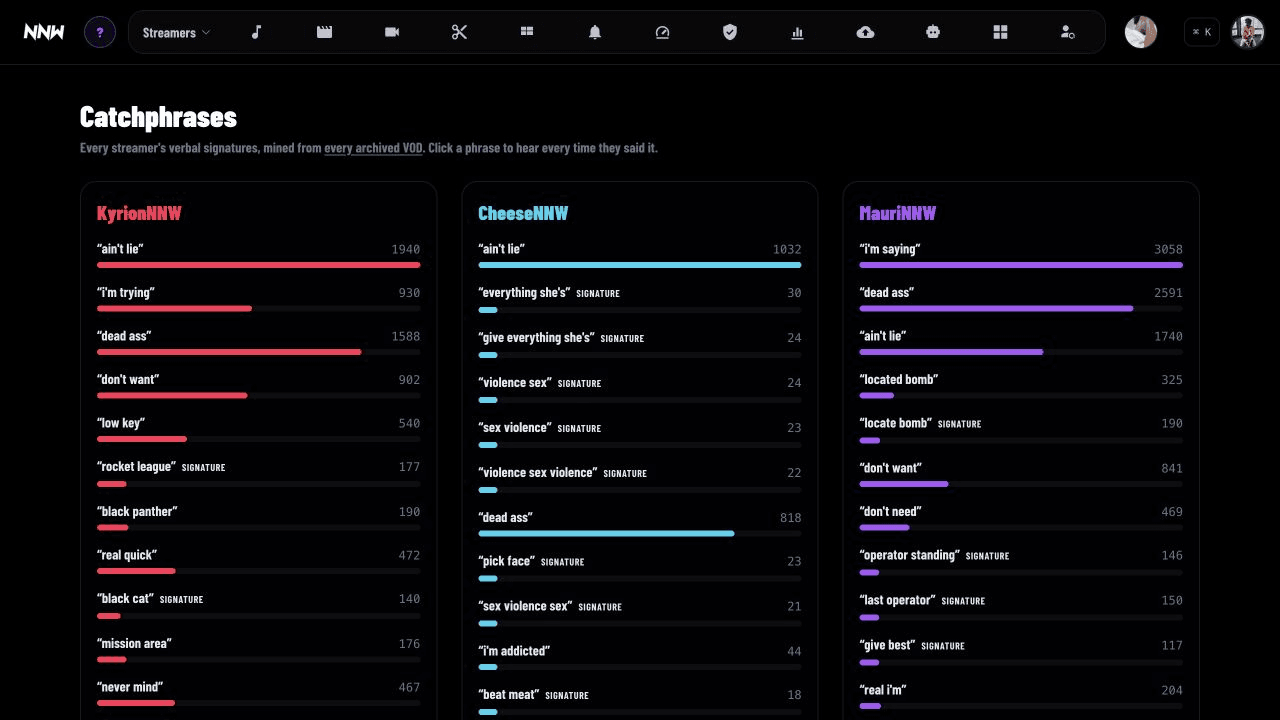
Find patterns across the archive
The transcript layer also aggregates recurring language across creators, turning an archive into a comparative research tool.
- Counts are derived from archived public transcripts.
- A phrase can be traced back to the moments where it appeared.
System boundary
A readable flow, not a deployment map.
This is the level of architecture useful to a product reviewer: responsibilities and handoffs, without schemas, endpoints, thresholds, or topology.
- Stream end
- Media ingest
- Archive record
- Transcript index
- Cited retrieval
Scope
What the system owns.
- 01
Detects stream end and ingests full VOD media automatically.
- 02
Handles deduplication, multipart upload, captions, and timestamp mapping.
- 03
Indexes broadcast transcripts for archive-wide full-text search.
- 04
Returns retrieval-augmented answers with citations to exact archived moments.
Results
What changed.
- Turned a growing video archive into a searchable research surface.
- Preserved the link between transcript evidence and source-media timestamps.
- Automated repetitive ingest and archive bookkeeping after each broadcast.
Technology
Built with.
Python, yt-dlp, FFmpeg, YouTube API, SQLite FTS5, LLM APIs